-
Location: Mediterranean coast, 220 km northwest of Cairo
-
Best for: Greco-Roman history, coastal atmosphere, seafood, a break from Cairo’s intensity
-
Ideal visit length: 1 full day (day trip from Cairo) or 2 days for a relaxed pace
-
Best seasons: March–May and September–November (20 °C–28 °C, low humidity)
-
Getting there: 2.5–3 hours by car or train from Cairo
Here is a quick reference for the main Alexandria things to see and their approximate visit time:
| Attraction | Visit Time | Entry Fee (approx.) | Highlight |
|---|---|---|---|
| Catacombs of Kom El Shoqafa | 45–60 min | 100 EGP (~$2) | Largest Roman burial site in Egypt — Egyptian-Greek-Roman fusion art |
| Qaitbay Citadel | 45–60 min | 60 EGP (~$1.20) | 15th-century fortress on the site of the ancient Lighthouse of Alexandria |
| Bibliotheca Alexandrina | 1–2 hrs | 70 EGP (~$1.40) | Modern library honouring the ancient Great Library; planetarium and museums inside |
| Pompey’s Pillar | 30–40 min | 100 EGP (~$2) | 25-metre granite column, tallest ancient monolith in Egypt |
| Roman Amphitheatre (Kom El-Dikka) | 30–45 min | 100 EGP (~$2) | 13-tier marble theatre with intact Roman mosaics and villa ruins |
| Alexandria National Museum | 1–1.5 hrs | 100 EGP (~$2) | Pharaonic, Greco-Roman, Coptic, and Islamic artefacts in one building |
| The Corniche | 1–2 hrs (walk) | Free | 15-km seafront promenade — sunset views, cafes, fishermen |
| Montazah Palace Gardens | 1–2 hrs | 25 EGP (~$0.50) | Royal gardens of King Farouk with beach access |
Exchange rates fluctuate — verify current rates before travel. Entry fees based on non-Egyptian visitor pricing at the time of writing.
Top Alexandria Things to See and Do
Catacombs of Kom El Shoqafa
Descend a spiral staircase roughly 35 metres underground and you enter the largest known Roman burial site in Egypt. Dating to the 2nd century CE, the three-level complex served as a family tomb before expanding into a mass necropolis holding over 300 burials. What makes it extraordinary is the art: Egyptian gods wearing Roman military uniforms, Greek-style decorations framing pharaonic death scenes, and carved serpents blending all three traditions into something found nowhere else.
The main tomb features a vestibule, a rotunda, and a triclinium (funeral banquet hall) where mourners gathered. Deeper down, the Hall of Caracalla contains horse and human bones believed to date from a mass execution ordered by Emperor Caracalla in 215 CE. The temperature drops noticeably underground — a welcome contrast if you visit in summer.
Photography is allowed without flash. The staircase is narrow and can be slippery; wear closed-toe shoes with grip. The site is usually less crowded before 10:00.
Qaitbay Citadel
At the tip of Alexandria’s Eastern Harbour, where the ancient Pharos Lighthouse once stood — one of the Seven Wonders of the Ancient World — Mamluk Sultan Qaitbay built this defensive fortress in 1477 CE using some of the lighthouse’s own fallen stone blocks. An earthquake destroyed the lighthouse in 1323 CE, and the citadel rose on its foundations a century and a half later.
The fortress is compact enough to explore in under an hour. Climb to the upper ramparts for a wide-angle view of the Mediterranean, the harbour, and the city skyline. Inside, a small naval museum displays model ships and artefacts from maritime battles. The area around the citadel is popular with families, fishermen, and couples walking the breakwater rocks at sunset. A typically includes Qaitbay as the final stop before the return drive to Cairo, and the late-afternoon light makes it the best time to visit.
Bibliotheca Alexandrina
The original Library of Alexandria, founded in the 3rd century BCE under the Ptolemaic dynasty, was the ancient world’s greatest repository of knowledge. It was destroyed gradually over centuries — fire, neglect, and political upheaval all played a part. The modern Bibliotheca Alexandrina, opened in 2002, was built to honour that legacy.
The building itself is the first attraction: a tilted disc-shaped roof covered with characters from 120 different scripts, facing the sea. Inside, the main reading hall spans 11 storeys and seats over 2,000 readers under a vast skylight. The library complex also houses four museums (the Antiquities Museum is the strongest, with Pharaonic, Greek, and Roman artefacts), a planetarium, and rotating art exhibitions.
The library is closed on Fridays. On other days, doors open at 10:00 and close at 19:00 (hours may vary seasonally). Budget at least 90 minutes to see the reading hall, the Antiquities Museum, and the exterior sculptures. If your visit falls on a Friday, you can still photograph the striking exterior and walk the surrounding waterfront plaza.
Pompey’s Pillar and the Serapeum
A single 25-metre column of red Aswan granite rising from a hilltop — the tallest surviving ancient monolith in Egypt. Despite its name, the pillar has nothing to do with the Roman general Pompey. It was erected around 297 CE to honour Emperor Diocletian after he ended a siege and brought grain to the starving city. The column once stood at the centre of the Serapeum, a vast temple complex dedicated to the Greco-Egyptian god Serapis.
Little of the Serapeum survives above ground, but underground galleries are accessible and contain niches that may have stored overflow scrolls from the Great Library. Two pink granite sphinxes guard the site. The hilltop position gives panoramic views across Alexandria’s rooftops — particularly atmospheric in the morning light.
The Roman Amphitheatre (Kom El-Dikka)
The only Roman amphitheatre discovered in Egypt. Thirteen semicircular tiers of white and grey marble seat roughly 800 spectators. Archaeologists believe it was used for musical performances, lectures, and public gatherings rather than gladiatorial combat. The acoustics remain sharp — stand at the centre and speak normally, and listeners on the top row can hear every word.
Adjacent to the theatre are the ruins of Roman villas with remarkably intact mosaic floors, including the celebrated “Villa of the Birds” — a floor mosaic depicting doves, parrots, and other birds in vivid polychrome detail. The site also includes the remains of a Roman bathhouse (thermae) with underfloor heating channels still visible.
Kom El-Dikka sits in the city centre, a short walk from Misr Railway Station and an easy stop to combine with Pompey’s Pillar.
Alexandria National Museum
Housed in a restored Italian-style palazzo on Tariq El-Horreya street, this museum walks you through Alexandria’s layered history across three floors. The basement covers the Pharaonic period, the ground floor the Greco-Roman era, and the upper floor Coptic, Islamic, and modern artefacts — chronologically ascending as you climb.
Highlights include a Ptolemaic-era statue with Greek facial features on a pharaonic body (the cultural fusion of Alexandria in one object), Tanagra figurines, Coptic textiles, and Islamic-era coins. The museum is smaller than Cairo’s major institutions, which works in its favour: you can absorb everything in 60–90 minutes without museum fatigue.
The Corniche — Alexandria’s Waterfront
Not a single monument but a 15-km coastal promenade stretching from Qaitbay Citadel in the east to Montazah Palace in the west. Walking even a portion of it gives you the feel of Alexandria that no indoor attraction can: fishing boats bobbing in the harbour, families eating corn from street carts, couples leaning on the railings watching the Mediterranean, and a steady breeze that drops the temperature several degrees below inland Cairo.
The stretch between the Bibliotheca Alexandrina and the Citadel is the most photogenic, especially at sunset. Street-side cafes serve strong Turkish coffee and shisha. The Corniche is free, always open, and arguably the single most atmospheric experience in the city.
Montazah Palace and Gardens
At the eastern end of the Corniche, this former royal residence of King Farouk — Egypt’s last monarch — sits on a bluff overlooking a private beach and 150 acres of manicured gardens. The palace itself is closed to visitors, but the grounds are open and offer palm-shaded paths, flower beds, a tea garden, and direct beach access.
Montazah is the place locals go on weekends. It is calmer and greener than the central city and ideal for an afternoon wind-down after a morning of temple-heavy sightseeing. Entry is 25 EGP. Bring a towel if you want to swim — the beach is sandy and relatively clean by Egyptian standards.
Abu al-Abbas al-Mursi Mosque
Alexandria’s largest and most ornate mosque, named after the 13th-century Andalusian Sufi scholar buried within. The current structure, rebuilt in 1943, features a high central dome, four smaller domes, intricate Islamic geometric patterns, and a tall minaret visible from much of the Eastern Harbour.
Non-Muslim visitors are generally welcome outside prayer times. Remove shoes at the entrance and dress modestly — shoulders and knees covered, women should bring a headscarf. The mosque sits near the Corniche, a short walk from Qaitbay Citadel, and adds architectural variety to a day otherwise dominated by Greco-Roman sites.
Alexandria Things to See on a Day Trip from Cairo
A day trip is the most common way international visitors experience Alexandria. The 220 km drive takes 2.5–3 hours each way by private car, leaving roughly 7–8 hours for sightseeing — enough for four to five major sites plus lunch.
A realistic day-trip schedule looks like this: depart Cairo at 07:00, arrive in Alexandria by 09:30–10:00, visit the Catacombs and Pompey’s Pillar in the morning, lunch at a seafood restaurant by the Mediterranean, then the Bibliotheca Alexandrina (or exterior photo stop if it is Friday), and finish with Qaitbay Citadel before driving back around 17:00–18:00. You return to your Cairo hotel by 19:30–20:30.
Trying to add Montazah, the National Museum, and the Roman Amphitheatre to a single day makes the schedule rushed. Pick four or five sites and give them proper time rather than sprinting through seven.
A handles all the logistics — private car, Egyptologist guide, entrance fees, and a seaside lunch — so you focus entirely on the experience rather than navigation and tickets.
Best Time to Visit Alexandria
Alexandria’s Mediterranean climate is milder and more humid than Cairo or Upper Egypt. Summers are hot but less extreme than inland; winters are cool and occasionally rainy.
| Season | Months | Temp Range | Conditions | Crowds |
|---|---|---|---|---|
| Spring (ideal) | Mar–May | 18 °C–28 °C | Warm, clear, comfortable walking | Moderate |
| Summer | Jun–Aug | 26 °C–33 °C | Hot, humid, very crowded with Egyptian holidaymakers | High (local) |
| Autumn (ideal) | Sep–Nov | 20 °C–30 °C | Warm, sea still swimmable, fewer tourists | Low–Moderate |
| Winter | Dec–Feb | 10 °C–18 °C | Cool, occasional rain, grey days | High (international tourists in Egypt) |
March through May and September through November offer the best balance: pleasant temperatures, manageable crowds, and clear skies for photography.
How to Get from Cairo to Alexandria
Private car (recommended for day trips): 2.5–3 hours via the Cairo–Alexandria Desert Road. A private tour includes door-to-door transfers with an English-speaking driver. This is the most flexible option and eliminates the stress of navigating Alexandria’s one-way streets.
Train: Egyptian National Railways runs multiple daily services from Cairo’s Ramses Station to Alexandria’s Misr Station (also called Sidi Gaber). First-class tickets cost approximately 100–150 EGP ($2–$3) and the journey takes about 2.5 hours. Trains with air conditioning depart several times in the morning; the 08:00 departure is popular. Book at least a day in advance during holidays.
Bus: Go Bus and West & Mid Delta operate frequent services from Cairo’s Turgoman and Abdel Moniem Riad stations. Journey time is 3–3.5 hours. Fares start at around 150–250 EGP ($3–$5). Buses are air-conditioned but less comfortable than trains for longer passengers.
Domestic flight: Not commonly used for this route — the drive is short enough that flying adds no real time savings once you factor in airport procedures.
Where to Eat in Alexandria
Alexandria is Egypt’s seafood capital. The Mediterranean coast supplies fish, shrimp, calamari, and crab that you will not find at this freshness level in Cairo.
Balbaa Village — One of the most popular seafood restaurants among locals and visitors alike. Choose your fish from a display counter, pick your cooking style (grilled, fried, baked, or in a tagine), and it arrives with tahina, salads, rice, and fresh bread. Located on the Corniche near Abu Qir.
Fish Market (Kadoura area) — Several waterfront restaurants cluster near the fish market in Anfushi. Fish by weight, served simply and fresh. Prices are per kilogramme; expect roughly 200–400 EGP ($4–$8) per person for a generous meal.
Abou Ashraf — A long-standing neighbourhood favourite near Raml Station. Known for mixed seafood platters and molokhia with shrimp.
Street food on the Corniche: Grilled corn on the cob (5–10 EGP), foul and falafel sandwiches (10–20 EGP), and sugarcane juice (10 EGP) from vendors along the waterfront. Budget meals do not get fresher.
For a more curated lunch experience, the includes a meal at a selected seaside restaurant with Mediterranean views.
Practical Tips for Visiting Alexandria
Dress code: Alexandria is more cosmopolitan than Upper Egypt, but it remains a conservative city. Cover shoulders and knees when visiting mosques. At outdoor sites and the Corniche, casual clothing is fine — shorts and t-shirts are common among tourists, though local women generally dress modestly. Bring a light jacket or sweater: the sea breeze can feel cool, especially in the morning and after sdahabiyaRiverunset.
Money: ATMs are widely available along Tariq El-Horreya and near major sites. Egyptian pounds (EGP) are preferred for smaller transactions. US dollars and euros are accepted at some hotels and restaurants but not at street vendors or markets. Credit cards work at upscale restaurants and hotels but not at most attractions — carry cash.
Language: Arabic is the official language. English is spoken at tourist sites, hotels, and tour-oriented restaurants. Knowing a few Arabic phrases — shukran (thank you), bikam da? (how much is this?), la shukran (no thank you) — helps in markets.
Safety: Alexandria is generally safe for tourists. The main risks are traffic (pedestrian crossings are a suggestion, not a rule), petty scams from unlicensed guides near major sites, and occasional street harassment (mostly verbal, directed at women). Stay aware of your surroundings, keep belongings close in crowded areas, and decline unsolicited assistance from strangers at ticket counters.
Photography: Most sites allow photography without flash. Some interior sections of the Catacombs and the Bibliotheca have restrictions — look for signage or ask your guide. Always ask permission before photographing local people.
SIM / eSIM: The same Egypt SIM or eSIM that works in Cairo works in Alexandria. Vodafone and Orange both have strong coverage throughout the city.
Sample Alexandria Day Trip Itinerary
This schedule assumes departure from Cairo with a private car and guide — the same format offered by the .
07:00 — Depart Cairo Private air-conditioned car picks you up from your hotel. The drive to Alexandria takes approximately 2.5–3 hours via the Desert Road, with a brief rest stop.
09:30 — Catacombs of Kom El Shoqafa Start underground. The catacombs are cooler in the morning and less crowded before tour buses arrive around 11:00. Allow 45–60 minutes.
10:30 — Pompey’s Pillar A 10-minute drive from the Catacombs. Explore the pillar, the underground galleries, and the sphinx pair. Good morning light for photos from the hilltop. Allow 30–40 minutes.
11:15 — Alexandria National Museum Walk through three floors of the city’s history in chronological order. Allow 60–90 minutes.
12:45 — Lunch by the Mediterranean Seafood at a waterfront restaurant in Anfushi or along the Corniche. Relax, enjoy the view, and recharge. Allow 60–75 minutes.
14:00 — Bibliotheca Alexandrina Tour the reading hall, the Antiquities Museum, and the exterior sculptures. Closed on Fridays — if your trip falls on a Friday, swap this for the Roman Amphitheatre at Kom El-Dikka instead. Allow 60–90 minutes.
15:30 — Qaitbay Citadel Finish the day at the citadel. Explore the fortress, walk the breakwater, and watch the light soften over the harbour. Allow 45–60 minutes.
16:30 — Corniche Walk (optional) If time allows, stroll a portion of the waterfront between the Citadel and the Bibliotheca before heading to the car.
17:00 — Depart for Cairo
? Is a Nile cruise worth it
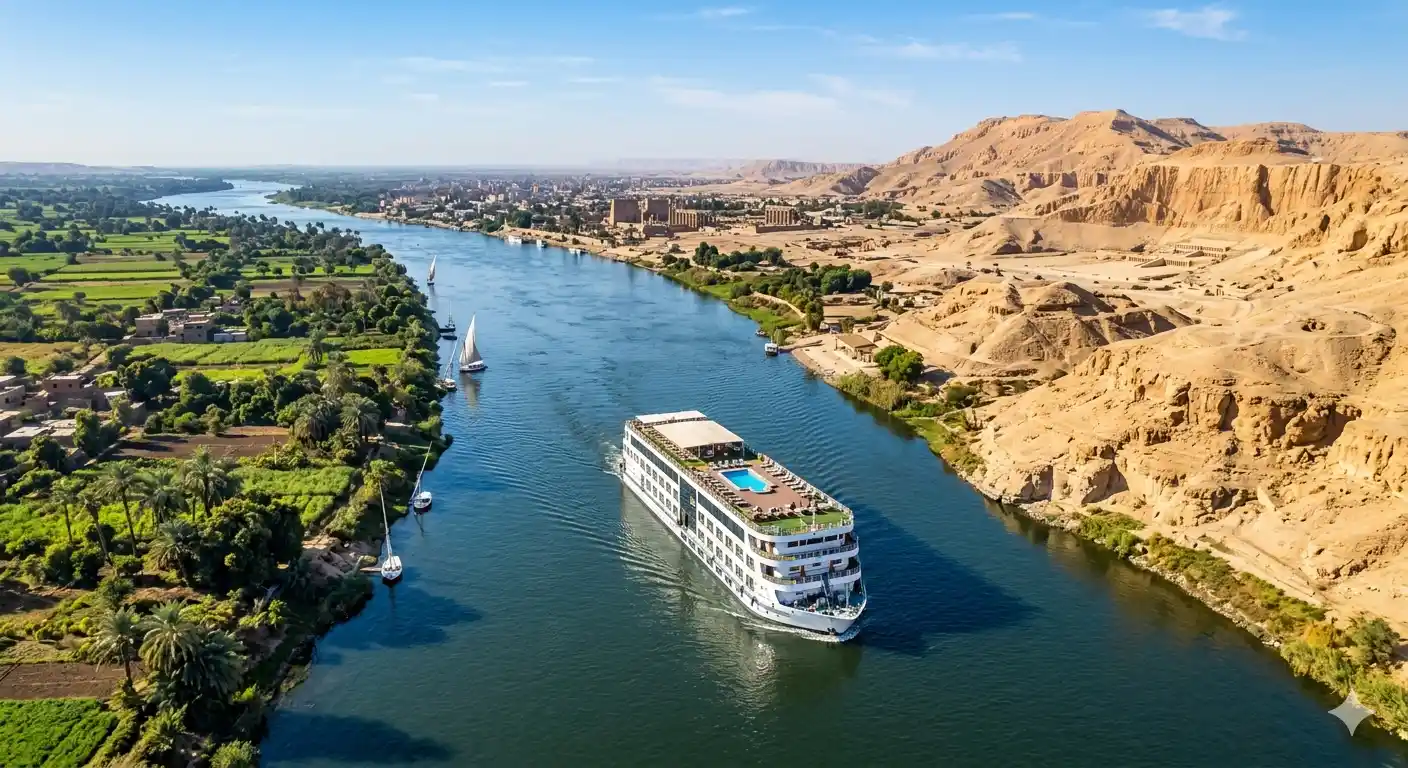
For first-time visitors to Egypt, a Nile cruise is among the most effective ways to experience Upper Egypt. It eliminates the need to arrange separate transport, accommodation, and guides for each temple. You unpack once, and the ship moves you between sites while you sleep, eat, and relax. The views from the sundeck — green farmland giving way to sand dunes, fishermen in wooden boats, children waving from the bank — are part of the experience that road travel cannot replicate
The value depends on your priorities. If your goal is to see Karnak, the Valley of the Kings, Edfu, Kom Ombo, and Philae in a structured, comfortable format, a Nile cruise delivers that efficiently. If you prefer total independence and spontaneous scheduling, a self-guided road trip between Luxor and Aswan with a private driver may suit better
? How many days is a typical Nile cruise
Three to five nights for a one-way trip between Luxor and Aswan. Seven nights for a round-trip sailing. When combined with two to three days in Cairo and an optional Abu Simbel visit, the total itinerary runs 7–12 days. The [Nile cruise itinerary planning guide walks through each route option in more detail
? What is the best month for a Nile cruise
October through April offers the most comfortable temperatures for temple visits. December and January are the most popular (and most expensive) months, with daytime highs around 22 °C–26 °C. March and October are excellent shoulder options — fewer crowds, 15–20% lower prices, and warm but tolerable temperatures. Avoid June through August unless you are very heat-tolerant; Luxor routinely exceeds 40 °C in midsummer
Is Egypt safe for solo travelers on a Nile cruise?
Organized Nile cruises are well-suited to solo travel. You are on a ship with a fixed itinerary, a guide, and other passengers — the structure minimizes the challenges that solo travelers might face elsewhere in Egypt. Most operators offer single-occupancy cabins, though a supplement applies (typically 50–80% of the double rate)
Female solo travelers should expect attention in markets and public spaces — persistent vendor approaches and occasional catcalling — but the cruise ship environment itself is controlled and comfortable. Practical tips: dress modestly at temples, keep your hotel and cabin details private, and trust the advice of your guide over unsolicited help from strangers. The [solo traveler guide to Egypt addresses these situations in depth
? What is the dress code on a Nile cruise
Onboard: relaxed during the day (shorts, t-shirts, swimwear by the pool), smart-casual for dinner (collared shirts, dresses, no flip-flops in the dining room). Most ships host one or two themed evenings where passengers wear a galabiya — a traditional Egyptian robe you can buy at port markets for $15–$25
Off-ship: cover shoulders and knees at temples and mosques. Lightweight long trousers, a loose shirt, and a scarf for women handle nearly every situation
? Do I need a visa for Egypt
At the time of writing, citizens of most Western countries can obtain a tourist visa on arrival at Egyptian airports for $25 (cash, payable in USD, EUR, or GBP) or apply for an e-visa in advance through the official portal (visa2egypt.gov.eg) for roughly $25. Your passport must be valid for at least six months beyond your arrival date. Some nationalities require pre-arranged consular visas — check with your nearest Egyptian embassy
? What food is served on a Nile cruise
Full-board ships serve Egyptian and international cuisine at every meal. Breakfast buffets include foul medames (stewed fava beans), falafel, eggs, cheese, and fresh bread. Lunch and dinner rotate between grilled meats, fish, rice dishes, fresh salads, and Egyptian specialties like molokhia (jute leaf stew), koshary (lentils, rice, and pasta), and mahshi (stuffed vegetables). Fresh fruit — mangoes, guavas, dates — is plentiful